"Capital cannot do without labor, nor labor without capital. Mutual agreement results in the beauty of good order, while perpetual conflict necessarily produces confusion and savage barbarity."
- Pope Leo XIII

What is Corporatism?
The first and most important thing to keep in mind is that Corporatocracy is not Corporatism.
Corporatocracy is rule by business interests, and we are vehemently opposed to Corporatocracy as it only benefits a handful of corrupt elites while making life worse for everyone else. As for Corporatism, it comes from the Latin word corpus, which means body. The idea is that all the sectors of the economy are parts of the body which are directed by the state, or brain. The health of the body depends on the health of its parts, and the brain uses those parts in unison to accomplish goals beyond the scope of each individual part.
Corporatism describes an economic system where business interests are regulated by the government (to varying degrees), and the government, of course, must answer to the people. The goal of a system like Corporatism is to use the state to protect the workers from exploitation, avoid destructive class wars that Marxists advocate for, protect the right of people to own things, and lead the country to a more prosperous state where national and economic well-being is balanced.
In a corporatist system, all the companies of a category of industry would be organized into a "guild" or "syndicate" of sorts. For example, Nucor, Steel Dynamics, CMC, and other major steel-makers could be organized into a steel guild. Within that guild, there would be representation for labor groups and business groups (workers and owners). A third neutral party, the state, oversees all the guilds and negotiates with both workers and owners to reach a favorable compromise that would satisfy both sides and benefit the country as a whole. This is commonly referred to as a tripartite system, shown in a graphic under this section.
A big and unavoidable criticism of Corporatism is that it was the economic system of the Fascist states of the 20th century, and that Corporatism requires a totalitarian state. This is a disingenuous statement. Corporatism, while it does require a strong government to stand up to business interests, does not have to be anti-democratic. The most famous example of "democratic corporatism" is those of the Nordic countries, in which the state played a much more laid-back and regulatory role, which we have no problems with. We have no desire to implement a totalitarian and undemocratic government in America for a variety of reasons, the most important being that it is neither realistic nor American to do so.
The state, or government, makes laws and holds legitimate authority. It is in the interests of everyone involved that the state remains healthy, powerful, and that the people of the nation recognize and legitimize the authority of the state.
Businesses possess capital and the ability to organize and direct capital towards productive forces. Business has a crucial role regarding assets, private property, and large scale complex economic action.
Workers are the nation, and they are the lifeblood of the economy on which everything rests. Workers are numerous but disorganized, but under our system they will be valued and given powers to fight for their interests.
Corporatism in America
A system like this is possible to implement in the unique American political system. The main thing is to ensure the neutrality of the government. To keep it short and sweet, we would aim to create a properly informed, and most importantly, politically active populace combined with transparency for the actions of government officials to ensure that the state does not pick favorites. In essence, the three sectors of the tripartite would have checks and balances, the same concept as our current government branches.
To simplify a proposed corporatist system in the United States, we would have industries be organized into their respective guilds. Those guilds would be comprised of two separate groups with equal power: worker groups (like unions) and owner groups (employers associations). The labor unions and the employer associations would then choose a set and equal number of representatives to represent their own separate interests in the federal government. The federal government would act as a mediator with those representatives to negotiate and agree on baseline rules that both sides can agree on. Those baseline rules could include minimum wages, benefits, and regulations. After that is agreed on, regional representatives (which represent several states in a geographically cohesive region) would initiate a second round of negotiations to tailor those new rules for their specific region. The goal of this is to establish a relatively uniform implementation of economic policy without neglecting the unique needs of local communities. The mediatory role of the state would prevent it from becoming too powerful as well.
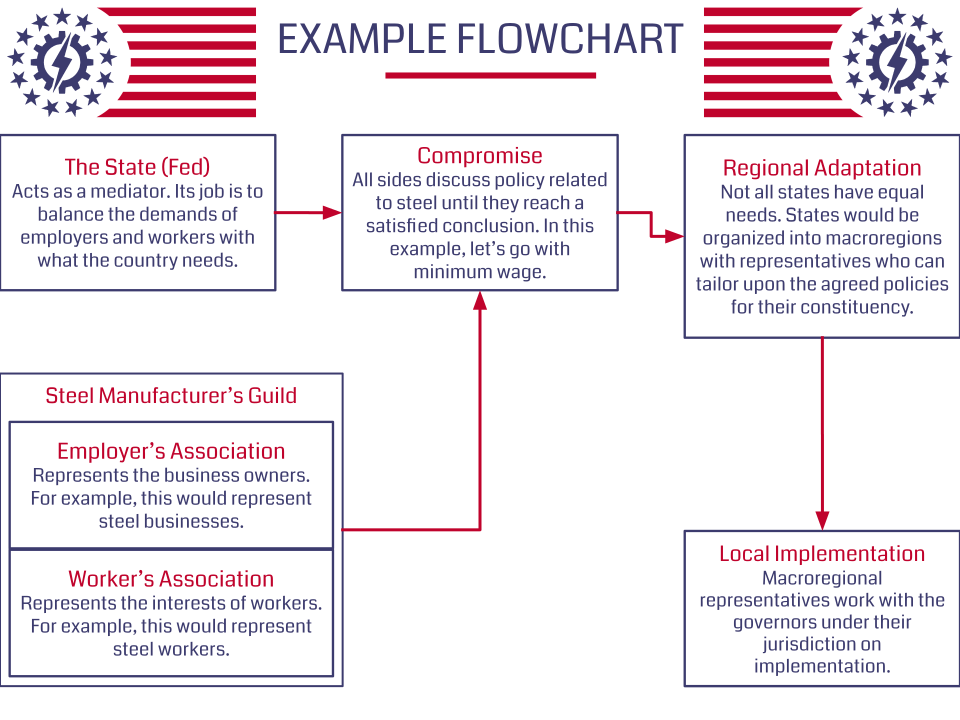
In order to ensure this system works, many changes would need to be made. For example, "right-to-work" laws would need to be revised, and lobbying for business interests would need to be banned (which is great, of course). Additionally, because we recognize the importance of liberty in our society, it is really only large powerful businesses that would be subject to the tripartite system. Small businesses are not only an American right, but more importantly, they do not, and historically have not, had the power to damage the well-being of our society.
A major goal is to overturn Dodge v. Ford Motor Co. (1919). To keep it brief, this court case set a precedent that businesses must serve the interests of shareholders, who only care about turning a profit. Although there have been many more modern laws and precedents established to build on Dodge v. Ford or even render it irrelevant, it cannot be ignored that this case laid the foundation for further infringement on the well-being of the public. It is Dodge v. Ford which has allowed for the complete destruction of the well-being of our great nation's people, environment, and communities in the name of infinite growth. It is Dodge v. Ford that has allowed for the most inhumane and psychopathic among us to rise to positions of power over millions of people. As both a nationalist and corporatist organization, Dodge v. Ford's continued existence is unacceptable for the well-being of the public and is antithetical to the success of our proposed economic system.